
You are now subscribed
Your newsletter sign-up was successful
Want to add more newsletters?

Twice daily
MoneyWeek
Get the latest financial news, insights and expert analysis from our award-winning MoneyWeek team, to help you understand what really matters when it comes to your finances.

Four times a week
Look After My Bills
Sign up to our free money-saving newsletter, filled with the latest news and expert advice to help you find the best tips and deals for managing your bills. Start saving today!
What’s happened?
Earlier this month, the Nobel Prize in economics was awarded to three academics noted for exploring the two most urgent practical questions in their discipline: why do economies grow, and how can we help them do so? Half the $1.2 million (11 million Swedish kronor) prize was given to Joel Mokyr, an American-Israeli economic historian of the industrial revolution in Britain and its scientific and cultural underpinnings. The other half of the prize was shared between Philippe Aghion (of the London School of Economics) and Peter Howitt (of Brown University in the US). The pair are growth theorists best known for their Schumpeterian model of economic growth, focused on innovation and “creative destruction”. The choice of these laureates is a reminder that significant and steady economic growth is a relatively recent phenomenon, merely a few centuries old, and that we take it for granted at our peril.
What drives economic growth?
A growing population, rising productivity and labour-market flexibility are what drive long-run economic growth, and of these, productivity is the biggest factor. As for what drives that, the first building block is having a well-functioning market economy, alongside a stable regulatory regime that allows enterprises to flourish. A second is having access to global markets and high levels of investment in both physical capital and human resources, in the form of skills and education. But all that would mean little without technological innovation. The UK economy is delivering more than 15 times as much output per head of population as it was 200 years ago, mainly thanks to technological advances, particularly in key sectors such as manufacturing, transport and communications. By contrast, there was almost no improvement in living standards whatsoever in the four centuries between 1300 and 1700. This year, the Nobel committee chose to honour academics focused on the economic growth that has lifted billions of people out of poverty over the past two centuries. In the grand sweep of history, it’s been a highly unusual period – and there are no guarantees that it will continue.
What do the Nobel Prize winners say?
Mokyr’s work as an economic historian focuses on why growth took off in the first place. In A Culture of Growth, published in 2016, he argues that from the 17th century, European cultural norms changed in a manner that was conducive to scientific experimentation and discovery, and to the commercialisation of those ideas – especially in Britain. Compared with large and more monolithic states and empires in Asia, Europe’s political geography helped foster that change. Academics and innovators who fell out of favour could seek a safer harbour elsewhere. Governments were also more prepared to allow “creative destruction”, where old firms and products and sectors die, and new ones grow.
MoneyWeek
Subscribe to MoneyWeek today and get your first six magazine issues absolutely FREE

Sign up to Money Morning
Don't miss the latest investment and personal finances news, market analysis, plus money-saving tips with our free twice-daily newsletter
Don't miss the latest investment and personal finances news, market analysis, plus money-saving tips with our free twice-daily newsletter
Aghion and Howitt were recognised for their theory of sustained endogenous growth through creative destruction. The term “creative destruction” was coined in the 1940s by Joseph Schumpeter to encapsulate the idea that economic progress carries with it significant disruption, churn and displacement of older technologies and firms. The distinctive contribution of Aghion and Howitt, says Peter Kienow in a paper for the Centre for Economic Policy Research, is to have “transformed creative destruction from an evocative metaphor into a rigorous analytical framework” and mathematical model. The Aghion and Howitt framework, dating from 1992, allowed growth theory to integrate real-world micro-data on firm and product dynamics, and built a platform for decades of subsequent work on innovation and growth both by themselves and others – leading to “new insights about the social versus private returns to innovation, the distributional implications of innovation and potential political barriers” to it.
What can this year's Nobel Prize teach us?
The Nobel committee awarded the prize in the hope that the trio’s work would help ensure that growth was maintained and “steered in the direction of supporting humankind”. In accepting their prizes, the three laureates warned against policies that could hamper growth, including by restricting immigration and erecting trade barriers. But for the UK specifically, there are vital lessons above and beyond the need to be an open, trading nation, says Daniel Susskind in the Financial Times. Currently, the country’s growth strategy is focused on building its way out of stagnation. Yet the lesson from Mokyr, Aghion and Howitt is that “serious growth comes from a very different place: discovering new ideas, unleashing innovation and whipping up technological progress. In short, growth comes from the intangible world, not the tangible one”. If the UK had grown at the same rate as the US since the financial crisis, for example, Britons would each now be £8,000 richer (in terms of annual per capita GDP). That’s a massive gap in a short space of time, and it’s been driven by the UK and Europe more widely, falling behind in productivity-boosting technologies.
What should Britain do?
It should “focus on reforming intellectual property rights with the same intensity as planning reform”, says Susskind – which means “confronting the powerful creative industries trying to throttle reform on the use and re-use of new ideas in society”. It should also take research and development more seriously; our spending is below the average for the OECD club of rich nations. It should do far more to attract talented foreigners. It should tackle the pervasive sense within some of our most innovative industries – from finance to life sciences – that the UK is becoming a hostile place to operate. Above all, our education system should embrace new technology, not resist it. “Too many political leaders are drawing on old-fashioned ideas about what causes growth – to little effect.
This article was first published in MoneyWeek's magazine. Enjoy exclusive early access to news, opinion and analysis from our team of financial experts with a MoneyWeek subscription.
-
 ISA fund and trust picks for every type of investor – which could work for you?
Whether you’re an ISA investor seeking reliable returns, looking to add a bit more risk to your portfolio or are new to investing, MoneyWeek asked the experts for funds and investment trusts you could consider in 2026
-
 The most popular fund sectors of 2025 as investor outflows continue
It was another difficult year for fund inflows but there are signs that investors are returning to the financial markets


-
 Long live Dollyism! Why Dolly Parton is an example to us all
Dolly Parton has a good brain for business and a talent for avoiding politics and navigating the culture wars. We could do worse than follow her example
-
 Rachel Reeves is rediscovering the Laffer curve
Opinion If you keep raising taxes, at some point, you start to bring in less revenue. Rachel Reeves has shown the way, says Matthew Lynn
-
 The enshittification of the internet and what it means for us
Why do transformative digital technologies start out as useful tools but then gradually get worse and worse? There is a reason for it – but is there a way out?
-
 Michael Moritz: the richest Welshman to walk the Earth
Michael Moritz started out as a journalist before catching the eye of a Silicon Valley titan. He finds Donald Trump to be “an absurd buffoon”
-
 What turns a stock market crash into a financial crisis?
Opinion Professor Linda Yueh's popular book on major stock market crashes misses key lessons, says Max King
-
 ISA reforms will destroy the last relic of the Thatcher era
Opinion With the ISA under attack, the Labour government has now started to destroy the last relic of the Thatcher era, returning the economy to the dysfunctional 1970s
-
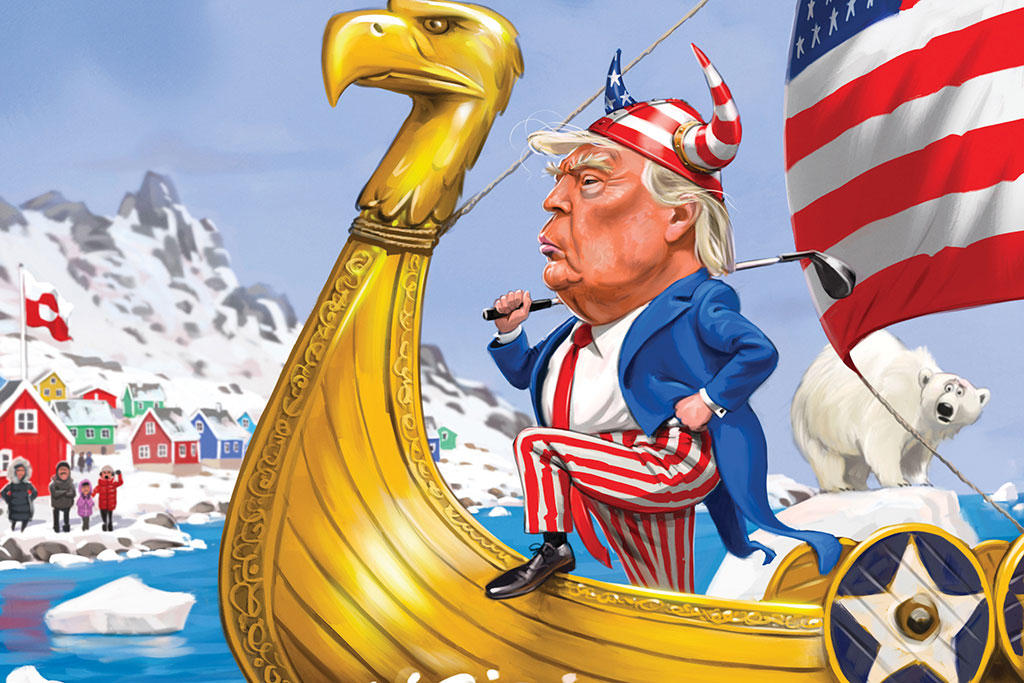 Why does Trump want Greenland?
The US wants to annex Greenland as it increasingly sees the world in terms of 19th-century Great Power politics and wants to secure crucial national interests
-
 David Zaslav, Hollywood’s anti-hero dealmaker
Warner Bros’ boss David Zaslav is embroiled in a fight over the future of the studio that he took control of in 2022. There are many plot twists yet to come


