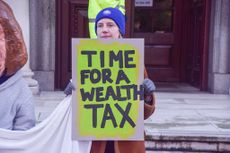
Should we have a land value tax?

By Simon Wilson Jul 29, 2011

Simon Wilson

Share with
friends:

Comments (40) Print this article

Land value tax has proponents from both the left and right wings of political thought. So should we implement it? Simon Wilson reports.

Why are property taxes in the news?

In an article for August’s Prospect magazine, the Organisation for Economic Co-operation and Development’s (OECD) chief economist, Pier Carlo Padoan, argues that Britain should scrap stamp duty and council tax and replace them with a recurrent property tax based on market values.

What’s the rationale?

As Louis XIV’s finance minister Jean-Baptiste Colbert once observed: “The art of taxation consists in so plucking the goose as to obtain the largest possible amount of feathers with the smallest possible amount of hissing.” The main advantage of direct taxes on property are they are tricky for even the rich to avoid. It’s hard to hide land or move it offshore to avoid getting taxed. For economists such as the OECD’s, there are two other big advantages: land taxes (they argue) increase long-term stability and growth by fostering more productive use of capital; and they stabilise government finances by bringing in revenue efficiently and quickly.

Would any political party here risk it?

It’s certainly a tough sell. Britain already has the highest property taxes in the rich world, at just over 4% of GDP (compared to an OECD average of less than 2%). In a downturn, in particular, homeowners are likely to be highly sceptical of any change they think might involve paying higher taxes overall. And the disaster of the poll tax (and the defenestration of Margaret Thatcher) are unlikely to encourage radical thinking on tax by UK politicians.

Nevertheless, there is a diverse and growing array of Liberal and Labour voices arguing for  just such a change. The Lib Dems have a pressure group (Alter) dedicated to winning support for a land value tax (LVT). Meanwhile, cabinet ministers Vince Cable and Chris Huhne both voiced support in their pre-cabinet days. In last year’s Labour leadership race, Andy Burnham made an LVT part of his manifesto (“an idea so ‘old Labour’ it can be traced all the way back to Thomas Paine”). And in Scotland an LVT is official Green Party policy. But it’s not just left-liberals who support an LVT.


Lead indicators for Britain's economy

Gold/silver ratio:
A warning for the markets
Where to next for
UK house prices?
Is Britain's inflation
about to take off?


Who else does?

Free-market capitalists and mainstream economists, such as the FT’s Martin Wolf and Samuel Brittan, have both argued the case in favour. Whereas left-liberals argue for land/wealth taxes on grounds of fairness and equality, free-marketeers tend to argue that the rapid accumulation of unearned property wealth over the last 15 years has made us all fat, lazy and unproductive. Tax wealth, so this theory goes, and we will be spurred into competing with fast-growing emerging markets. Right-wing libertarians also argue that wealth taxes are the least bad option because – paradoxically – they do the least to distort or depress wealth-creating economic activity. “Not only that,” says Tory Bow Group adviser Mark Wadsworth, “LVT is an entirely voluntary tax: you decide how much you are willing to pay and you choose a house or flat within that price range. Only, instead of handing over all the rent or purchase price to the owner, the location value would go to the government.”

Would it unlock the property market?

Both the left and right perspectives are concerned with the positive effects of a land tax on the next generation. The left worries that a whole generation will be excluded from property ownership. The right worries that letting the rich sit on the nation’s assets robs their children of incentives to work harder, damaging economic vitality. And everyone worries that concentration of property damages the social mobility that is crucial to future prosperity. The other argument in favour of a land tax (made by the doyen of LVT proponents Fred Harrison in his book Boom and Bust) is that taxing land encourages useful development. Landowners who accumulate it for speculation purposes face huge bills, encouraging them to sell up to developers with more of an incentive to put the land to work. Land-value taxes are not high on the political agenda so far, but they are an idea whose time may yet come.

Should the UK adopt a recurrent tax on property values?

No

• A new tax on property would destroy confidence in the fragile housing market and accelerate the decline in home ownership in Britain. 

• People buy homes out of taxed income. So unless income tax were abolished, a land tax amounts to double taxation and is inherently unfair.

• Proponents of land taxes hugely underestimate the difficulty of assessing the market value of all unsold land in the country. Without agreed values the tax cannot be levied.

Yes 

• The UK needs to be more productive, less lazy, and less property-obsessed. As the OECD points out, land taxes would smooth out damaging housing bubbles and encourage more productive investment.

• A land value tax would help address the inter-generational inequality between property haves and have-nots that was massively exacerbated by the long property boom of 1995-2007.

• A land tax is easy to collect, hard to avoid, and would help fund the large-scale infrastructural investment that the UK needs.

This article was originally published in MoneyWeek magazine issue number 548 on 29 July 2011, and was available exclusively to magazine subscribers. To read all our subscriber-only articles right away, sign up for a three-week free trial now.

Comments (40)

Share with
friends:

Comments

  • 1. Teresa

    (02 August 2011, 06:43PM)  Complain about this comment

    I have a minimum wage, 20 hour a week job. But I have savings enough to buy a small property.
    My dream is to own a small bungalow in the Welsh countryside and a couple of acres. Here, I will keep a horse, a couple of goats and some hens. I plan to grow my own fruit and vegetables, and to invest in solar panels and/or a wind turbine as soon as funds allow. I hope to live off-grid as much as possible, so that my job provides just enough cash for the things I can't manage myself.
    I have asked a major champion of the LVT, economist Fred Harrison, how a land value tax would affect my hopes and dreams. He removed my comment from his web site and never wrote back.
    I guess that's my answer, then, isn't it.

  • 2. Ellen

    (03 August 2011, 09:00AM)  Complain about this comment

    Anything that curtails greedy, world weary older people from preying on the needs of the young should be up for discussion. The generation who are under 20 now are expected to pay around £40k tuition fees. Then buy a tiny property for a hugely inflated pricetag. Then fund pension schemes of public sector workers who retired at age 60, and often younger (something they will never be able to do). On top of all that, the elderly want to keep thing like free travel and winter fuel allowence, higher state pensions all round and then the old person doesn't want to pay for their own care, even if they own a house. Apparently this is the expense of the already exploited younger generation. If LVT redresses some of this, its got to be a good thing.

  • 3. Will

    (09 August 2011, 11:17AM)  Complain about this comment

    Teresa

    I can't understand why you did not get an answer from Fred Harrison. You can contact ALTER on libdemsalter.org.uk to your answer questions.

    Under Land Value Tax, farms would be charged according to the value of their land, excluding the value of any improvements (drainage, fencing, buildings etc). The poorest land in use would not be expected to contribute to public expenditure because it benefited least from communally-created infrastructure or natural advantages. Land Value Tax charges would range from zero for the most marginal land, with higher assessments for intensive market gardening land.

    Rural land values in Wales are a faction of urban areas, so it would have little effect on you. Land Tax is a replacement for Council Tax and the 2 acres of farm land may not be taxed as the rental value would be so small. It’s possible you could pay less as its proposed each property would have a homestead allowance like a personal tax allowance.

  • 4. Will

    (09 August 2011, 11:57AM)  Complain about this comment

    "1. A new tax on property would destroy confidence in the fragile housing market and accelerate the decline in home ownership in Britain."

    How can it? First time buyers have fallen to record lows of 20% compared the 50% of purchaser’s in previous years. If any thing it would release more land for development and make housing more affordable.

    "2. People buy homes out of taxed income. So unless income tax were abolished, a land tax amounts to double taxation and is inherently unfair."

    The whole point of Land Tax is to take the majority out of Income Tax at a minimum, phased in over many years.

    "3. Proponents of land taxes hugely underestimate the difficulty of assessing the market value of all unsold land in the country. Without agreed values the tax cannot be levied."

    If that were the case a valuer could not do their job. There would be an appeals process and you can always sell the land if you don't agree.

  • 5. Mary

    (26 August 2011, 11:14AM)  Complain about this comment

    I think a mansion tax is a better idea. As long as it is set
    proportionately in the south east so people of modest means are
    not clobbered solely on the value of their property. or just return
    to good old fashioned rates and not have an upper limit. I agree
    the young are being unfairly penalised. The pensions of MPs
    should be severely curtailed and the inflation proofing for
    public servants retirement packages removed.

  • 6. Tim

    (26 August 2011, 11:29AM)  Complain about this comment

    With reference to the comments by ELLEN, (There are two sides to every story.)

    A few things she should know.

    Their old age pension was paid for out of the tax they paid whilst working (Not a hand-out.)
    They would be willing to give up free travel and fuel allowance if they had their pension increased fairly (i.e. by the annual inflation rate)

    But NO the government uses the inflation rate of September as the base for pension increase, the reason for this is because it is generally the lowest for the year.
    Do you call this fare?
    As to regard to selling their house for care in later life. Which most have bought them from money already taxed during their working life also remembering it was no easier to get started in their younger days than it is for young couples today.
    As opposed to people who never saved but spent all their money living in a care home free of charge.
    It really amounts to just one thing, you are penalized for being hard working and thrifty.


  • 7. Andrew the sensible

    (26 August 2011, 11:32AM)  Complain about this comment

    Yes but what about no new taxes - the inefficient public sector will just suck up and waste any money you give it.

    If you cut tax by 20% they'd still manage!

  • 8. greg

    (26 August 2011, 12:20PM)  Complain about this comment

    I'm all in favour of LVT - the current tax system creates too many market distortions and disincentives. Current council tax banding means that high value property is not taxed as much as it should be and land is not used efficiently... LVT would also discourage land banking... I also think that interest rates should not be manipulated by the BoE and that all printed money should backed by gold...

  • 9. Keith

    (26 August 2011, 01:03PM)  Complain about this comment

    If one considers the vast value of wealth tied up in property much, not all,of which is 'dead capital' ie is not income producing and then considers the need for capital into productive companies and industries which are crying out for new capital, to help us compete in the world markets, then all other issues are a bit irrelevant.
    The UK had 40 fat years on the back of north sea oil and a booming financial industry. Both of these are now in steep decline as major contributors to the Exchequer. Unless new industries are developed we will all decline whether we like it or not and no doubt we will have even more moaning and groaning. Sorry the tax is a must whether we like it or not. Fair or 'unfair'.

  • 10. Steve

    (26 August 2011, 02:01PM)  Complain about this comment

    Surely this would be more unfair than council tax already is.
    Council tax pays for maintainance of roads and pavements, street cleaning, refuse collection, leisure facilities, health and social care, etc etc. In other words it all aids the individual, so a family of four adults living together are using 4x the facilities than somebody living on their own. Yet the person on their own could be paying alot more in council tax.
    Bring back the Poll tax, as on paper this is alot fairer. It is only the fact that there was so much opposition from the feckless who have nothing to lose by rioting, that this wasn't implemented.
    As for making property affordable for all, they should think of some other way.

  • 11. Orb

    (26 August 2011, 02:52PM)  Complain about this comment

    I'm partially in agreement with Ellen - we aim to acquire ownership of our property, yet don't expect to be supported by the public purse when we can't look after ourselves; and I'd rather the thieving medical industry didn't experiment on me to see how long they can keep me alive, before selling my near-sell-by-date donated organs at some over-inflated 'no-cost-is-too-great-to-save-a-life' price to the next victim of their state-subsidised experimentations!

    As I've already stated in another article this week, I'm all in favour of exchanging a fair LVT and big VAT increase for income tax. That is the only realistic way to make the rich pay their fair share. Lets not kid ourselves: if you want to get rich, the easiest and most common way is exploitation.

    And Andrew the sensible is right too - just look how much councillors and mayors pay themselves, and we are powerless to regulate them! (voting only works in an ideal world!)

  • 12. Orb

    (26 August 2011, 02:53PM)  Complain about this comment

    Until last winter, our council tax bill was our biggest monthly expense, and for what??? The right to live in a tiny, cardboard 2-bed fridge where you can hear the neighbour using the loo, vacuuming, feeding the cat... Somebody explain to me how this £115k house, not built to 'legally required specifications' by some fatcat developer (now bust - what a surprise!) on the wrong side of the hill was banded 'C'??!!

    The Great British exploitation rip-off continues! Until the people find out how to stand up together, there will be no change; the government and their fatcat friends will just find ever more creative ways to fleece us. This mud island can only hold so many people... something's got to give!

  • 13. John

    (26 August 2011, 05:08PM)  Complain about this comment

    If we were starting from scratch, an LVT might be a good idea, but we are not. Under LVT, property values are lower. Such a tax would be unfair on existing property owners, since they paid more for their house than if LVT had existed, which is reflected in its current value.

    From memory, Schedule A was removed in 1962. This may well be one of the reasons why, when my wife and I bought our first house in 1965, prices had increased greatly.

    There may be little sympathy for someone with such a long period of property ownership (but the point is nonetheless still valid). What, however, of the person who bought his first house at the peak of the government-generated boom? He would have 'paid' twice over for government actions; first, the inflated house price caused by the 'boom', and then the reduction in value caused by the LVT.

    The only solution to this conundrum is a long phase-in period, perhaps fifty years.

  • 14. Supermarine Blues

    (26 August 2011, 05:11PM)  Complain about this comment

    Nicely-put article; the pros & cons are succinct & accurate.

    Even as a property capitalist (it's lazy but it IS [well, was!] the only show in town in UK) I can see the arguments for it and they are good ones. Especially linked to a VAT/flat tax regime, it might just help stop the rape of the middle-classes in our Gulag Archipelago, in favour of the super-rich and the urban sponger-classes.

    However, it's sadly true; it'd be soooo complicated to operate and would the gov't really let it work properly? If there's a chance to triple-tax or to employ more zombies to c0ck it all up for everyone, whaddy think will happen...

  • 15. Steve Lynham

    (26 August 2011, 08:15PM)  Complain about this comment

    With all this discussion on raising money by LVT, why are we as a nation throwing away almost £4 BILLION? In case you wonder, this is the NET LOSS to the UK of throwing out most International Students simply to satisfy the cry for cuts in immigration. The truth is that net immigration is high because (a) we HAVE TO allow in European citizens and many are coming, especially from eastern Europe. (b) Emigration has fallen because there are fewer jobs overseas. One newspaper today headlined "Immigration soared by 20%"; that did not take into account the fact that fewer UK citizens are leaving (although I can't imagine why everyone isn't trying to leave this sinking ship!).
    International students do not claim benefits but they do gain skills very useful to their home countries and whilst doing so they pay a net £4 BILLION to our finances. So instead of thinking of new taxes we should conserve the income we now have.

  • 16. Amateureconomist

    (26 August 2011, 09:39PM)  Complain about this comment

    Really interested parties should read "Progress and Poverty" by Henry George.

  • 17. Anto Bottrill

    (27 August 2011, 12:27AM)  Complain about this comment

    As a gen Xer on the cusp of Y I have watched the roller coaster of my fortunes I bought a house at 21,I saved the deposit myself and paid the mortgage alone.
    I bought in 1987 right at the peak of the last boom and had my interest increase to 19%...and damn near starved to pay it. Eventually I even had to move back home and rent it out for two years before I could afford to live in it again.
    I do not claim I have had it easy but how many people would be prepared to do that now?
    As John said,LVT would have to be have to be phased in very slowly to offset the much higher house values that all existing homw owners have already paid. One % per year ? Admin could be night-marish

  • 18. Clive

    (27 August 2011, 10:12AM)  Complain about this comment

    No to land/property/mansion taxes. To me, it's simply another example of tax by envy.

    I suspect most of those in favour don't live in the South East, where the bulk of the tax will come from. Lot of people will be saying "ah, but they're rich, they can afford it". What they really mean is "I'm in favour of it as it's a tax that doesn't impact me".

    Simply taxing property on it's monetary (£) value makes no allowance for living costs. Hence, despite living costs being massively higher in the SE, they'll have to pay the bulk of the taxes, due to property values in the SE.

    Same with so called mansion tax. People will be thinking "good, I don't have a £1million house, I'm in favour of it". They should think ahead a little. If such a tax came in, it wouldn't be long before the government - any party - would be lowering the threshold.

  • 19. Mez

    (27 August 2011, 11:00AM)  Complain about this comment

    I paid for the freehold on my property. I own the land, so I don't see why I should start paying rent to the State.

    It's just an excuse to obfuscate an overall tax hike, by changing from one method another. I predict another set of Poll Tax riots.

    Council Tax doubled under Labour - they should concentrate on just halving that back to where it was.

  • 20. DavePage

    (27 August 2011, 05:23PM)  Complain about this comment

    "...Britain already has the highest property taxes in the rich world, at just over 4% of GDP (compared to an OECD average of less than 2%)".

    The devil is in the detail, as ever. As a former UK resident and council tax payer (who gave up waiting for house prices to fall to normality and emigrated to the US), I can tell you that the UK does NOT have the highest property taxes in the developed world -- that would be America. The tax on our 1-bed DC apartment is $3000 / yr (~ £2000, equivalent to a mid-band detached house in the UK). Our friends pay $7000 for their detached two-bed house, and colleagues in Chicago, where we lived previously, pay over $40,000 a year for their 7-bed house...

  • 21. DavePage

    (27 August 2011, 05:24PM)  Complain about this comment

    ...
    $40k. £25,000 in council tax every year. So, not so bad after all, eh? Fortunately, house prices are not propped-up to save the indebted here and mortgage interest is deductable against tax, so it still makes more sense to buy here than back in the UK.

    Chavs, antisocial behaviour and riots all noticable by their absence too...

  • 22. JAW

    (27 August 2011, 05:40PM)  Complain about this comment

    Land Value Taxation: Land has a value which is actually created by the community. If no one lived in London the value of land in Regent Street would be minimal. There is a gradation of land values... high in city centres, low at the perimeter, lowest on derelict and marginal land.

    At present most of this land value created by the community is pocketed either by commercial and residential landlords, or by individual owners making capital gains. Economists discovering these principles suggested that if government was able to collect all these land values as a tax sufficient money could be raised to pay for all government services. All other forms of tax could be abolished. No more income tax, no corporation tax, no VAT, no Council Tax, etc. All undesirable since they inhibit production.

    LVT encourages production because you have to earn enough to pay the tax, if not you have to relocate to a cheaper site, making way for someone who can create the wealth to pay the tax.

  • 23. JAW

    (27 August 2011, 05:42PM)  Complain about this comment

    The idea that only one single tax is necessary sounds unbelievable, so I did some rough calculations to see what the average LVT might be for businesses, farms and residences etc. (NB the business/farm/dwelling ratios can be weighted differently)

    The average business would pay about £17,500 per year, a 250 acre farm about £4,000 per year, and the average house £3,500. These sums are reasonable considering someone who runs a small wholesale business from a single shop in the suburbs of London, employing 6 people, currently pays over £300,000 per annum in all forms of tax. The £3500 charge on a dwelling is not much more than the present Council Tax and less that the average rent.

    Obviously LVT is graduated with prestigious profitable businesses, which tend to operate in the centre of cities, paying much more, varying down to zero tax assessed on the most marginal sites. There has to be zero tax somewhere so that people can start from nothing. LVT is a tax with a humane side.

  • 24. JAW

    (27 August 2011, 05:46PM)  Complain about this comment

    The economics of LVT was devised in the early 20th century. It is based upon the concept that the centres of towns and cities are the places where the most profitable business takes place, where land values are the highest. But the world has evolved since then. Some businesses now operate from a computer in a bedroom, or from greenfield sites, country properties may be more valuable than those in cities.

    How can the tax be adapted to present economic conditions? Because the tax is assessed on the economic output of a site it is essentially the same as Corporation Tax, but with Landlordism marginalized, buy-to-let no longer profitable, and the holding of land and property which you do not use yourself, hoping for a capital gain untenable?

    On balance, LVT may result in a more equal society, greater opportunity, less exploitation. It encourages the transfer and release of land into the control of those who can use it more productively for the greater benefit of society.

  • 25. Roberto Birquet

    (27 August 2011, 08:56PM)  Complain about this comment

    Ellen
    Anything that curtails greedy, world weary older people from preying on the needs of the young should be up for discussion. The under-20 generation is expected to pay some £40k tuition fees; buy a tiny property for a hugely inflated pricetag; fund pension public sector workers who retired at 60, and younger (something they will never be able to do).
    ---and Ellen, save more for their own pension, while continuing to shop in our consumer economy; all, say many (see Matthew Lynn in latest issue) - for lower real wages than now. Does all this add up?
    of course not. LVT's time is come. And yes it should include a cut in standard rate income tax. Get Britain working!

  • 26. SamWannelce

    (29 August 2011, 12:17AM)  Complain about this comment

    People favour a land tax because they believe that someone else is going to pay it.

    Government will spend as much as you let it get away with.

    The last thing we need is another tax.

  • 27. Larry

    (29 August 2011, 08:49AM)  Complain about this comment

    We should abolish stamp duty and replace it with yearly property value tax.

    I'm trying to buy a place to live in London. I'm not short of cash. But I'm priced out of the market because 70% of the buyers are from overseas. They are buying places just to hang on to as "a pad in london" or a place to park their money. So we have a severe property shortage and at the same time we let people buy flats and not even live in them!

    Property is the basic asset that allows our economy to run. It's crazy that we allow people to hoard it. There needs to be every incentive to use it productively.

  • 28. John

    (29 August 2011, 10:57AM)  Complain about this comment

    Both land tax and mansion tax are discriminatory against long term property owners and south east England. Particularly against income poor. If land tax was implemented it would have to be done with many exemptions and phased in over a very long period, with all double and treble taxation eliminated.
    Can everyone trust the sort of governments we have in this country to implement it fairly? I think not. If implemented, the next socialist government will use it to "settle scores", "soak the rich" and the politics of envy will rule again.
    Would Teresa who is income poor but has saved all her life for 2 or 3 acres ever be able to achieve her dream?
    . . . .

  • 29. John

    (29 August 2011, 11:00AM)  Complain about this comment

    . . . .
    A good start to addressing the high property prices would be to
    a) take away the tax breaks on CGT and "improvements" which contributed to the property boom and still remain
    b) control morgage interest so that second home and multiple property owners pay at least RPI+x, whereas first time buyers much less.

    Also confusing land tax with rates is muddled thinking. Rates are for local services and should be applicable to everyone to pay their share. A form of income tax would be the fairest way.

  • 30. Peter Kellow

    (29 August 2011, 01:25PM)  Complain about this comment

    The key point that no one has mentioned so far is that LVT is a tax on holding an asset – not a tax on profits from selling or interest on that asset. So why not apply it to holding a painting, or a share, or even your car

    Assets can loose value. But with LVT you would continue to pay tax.

    Ultimately the poll tax was unacceptable because it was a tax on life not on economic activity. Your existential being was taxed! “I am, so I pay tax.”

    LVT is not quite as bad but ultimately it is bad for the same reason. It is a tax not on economic activity but on sitting there minding your own business.

  • 31. Andrew

    (29 August 2011, 01:28PM)  Complain about this comment

    Larry (27) is absolutely right. Foreigners investing in London property should pay more for the priviloege. After all, not too many Brits would choose to live in Moscow or Ryadh. We should charge heavily for political stability.

    Of course LVT is discriminatory. The South East would pay more, but people living there earn far more, they can afford it. In any case, the point about LVT is that it would be accompanied by a reduction in income tax - that is a must - to encourage employment and growth.

  • 32. Peter Kellow

    (29 August 2011, 01:40PM)  Complain about this comment

    Andrew and Larry want to introduce LVT because of foreigners parking their money in London property.

    We should not change our internal tax arrangements to accommodate activity by one relatively minor group like this.

    If we don't want foreigners buying up property like this introduce legal control on it. Simple!

    Not very Blatcherite I know, but we should have had enough of all that stuff.

  • 33. John

    (29 August 2011, 07:13PM)  Complain about this comment

    Andrew,
    You made a very sweeping statement above, when you said "The South East would pay more, but people living there earn far more, they can afford it."
    How do you know all people in the South East earn more comparitively? Also they pay higher prices and more tax.
    So you want to discriminate against them.
    And subject them to double and treble taxation.
    (Income tax, rates, LVT)
    And quadruple taxation if you include IHT as well.
    And flog them as well?
    This is purely the politics of envy.
    You are muddling the majority of ordinary people with fat cat bankers who we all resent.

    As pointed out above, LVT is tax on an asset that bears no relation to someones actual real wealth or income.

    As I said , excess property prices should be curbed by taxing the profits and more tax on loans and income from investment property, and cutting the loopholes, rather than unfairly penalising people just for living in a more expensive area.

  • 34. Pip

    (29 August 2011, 07:59PM)  Complain about this comment

    Bath & NE Somerset (BANES).
    Council budget net £123 mil.
    Non green belt area being 34% of total = 11,753 hectares = 117,530,000 m²
    Budget per m² = £1.04
    My council tax £1775 for 2011, plot size 200 m² = £8.88 / m²

    Largest nearby property plot size 1140 m² council tax £2403
    But at £1.04 / m² reduces to £1185.6

    Property prices ? It is the land which has increased in value over time at a ridiculous rate.
    Land held in short supply, not being produced these days, so hang tight and watch it's value soar with little tax implication - hence little input into local infrastructure.
    From Land Registry. South west
    1983 : £18.5 / m²
    2006: £234 / m²
    A whacking average of 11.7% per annum.
    I guess we can see why the wealthy invest in land, then restrict the supply !!
    Land tax could make some of 'em think twice about hanging on to it.
    -P-

  • 35. Supermarine Blues

    (30 August 2011, 10:10AM)  Complain about this comment

    Pip,

    RU sure? I think you need to take "inflation" out of those figures - it ought to be about about half that, depending on whether you fall for CPI or RPI.

    Either way, it's a tax on inflation (dangerous with a Labour Gov't!) and not related to activity. Furthermore, as Andy pointed out, most of the North of England is full of envious dole scroungers ;) so again, Gov't ends up paying it. Proper businesses can simply pass it on, whereas poor Gemma will have to pay in turnips or get dispossessed.

    But these points were all mentioned. The ultimate danger is it is a new tax and old taxes are NEVER repealed. We need to cull the zombies, not create more.

  • 36. Will

    (01 December 2011, 02:11AM)  Complain about this comment

    LVT main aim is to replace other taxes. Most supporters of LVT are either supporters or sympathetic to Henry Georges arguments in favour of Land Tax. He argued that taxes on incomes and enterprise created poverty, while unearned economic rent was extracted by the land owners that really belong to the community.

    So its not just another tax, it must replace other taxes, otherwise most of the benefits that supporters of LVT campaign for would be lost. All LVT supports talk about taxes it would replace or reduce.

    Land is different to other assets, it does not depreciate in value and it’s not Capital, as its value increases as the economy growths and community invests in its infrastructure. Its advantage is it does not tax economic activity, therefore as Milton Friedman said "So the question is, which are the least bad taxes? In my opinion the least bad tax is the property tax on the unimproved value of land, the Henry George argument of many, many years ago."

  • 37. Will

    (01 December 2011, 02:31AM)  Complain about this comment

    "If we were starting from scratch, an LVT might be a good idea, but we are not. Under LVT, property values are lower. "

    That is common misconception by many land tax supporters. In Denmark in 60's where there was choice local taxes, it was found areas with land tax had similar land values. As the enhanced economic activity generated by land tax enhanced land values, compensating for the land Tax. Hong Kong has very high land values and very land and property taxes raising 30-40% of government revenue compared to only 15% from income Tax. 61% of the work force pays no income tax, compared to 15% in the UK.

  • 38. DAVID

    (06 December 2011, 12:23PM)  Complain about this comment

    Lvt should be used to finance a basic TAX FREE income of 10k a yr for every adult.

  • 39. Lewis

    (02 February 2012, 12:57PM)  Complain about this comment

    Scrap Or Reform Council Tax Online E-Petition
    http://epetitions.direct.gov.uk/petitions/28434

  • 40. Mark Wadsworth

    (10 February 2012, 01:10PM)  Complain about this comment

    People like Steve crack me up, where do they get this nonsense from:

    "Council tax pays for maintainance of roads and pavements, street cleaning, refuse collection, leisure facilities, health and social care, etc etc."

    Oh no it certainly does not, Council Tax covers about one-fifth of the cost of all those things, the rest is paid for by grants from Whitehall out of general taxation. Epic fail.

Leave a comment

This will be the name displayed with your comment.

This helps us verify comments are genuine. It will not be displayed anywhere on the site and is stored confidentially.

Please keep your comment within 1,000 characters and relevant to the main topic. We encourage healthy debate, but we don't allow insults or bad language. Anything off topic or unpleasant, we'll remove. Enjoy the conversation! Thank you.

captcha To prevent spam-related comments please enter the characters shown in the 'Captcha' box to the left.

By leaving a comment you accept our terms and conditions.


>