Tax Freedom Day comes early – but it's not good news
By
Associate Editor
David Stevenson May 14, 2009
Print this article

Much bigger tax bills are on the way
Happy Tax Freedom Day!
Today's the day when the average Briton has earned enough to pay his annual tax bill. In other words, today you stop working for the Government, and start working for yourself. And the – apparent - good news is that this year, we're enjoying the earliest Tax Freedom Day since 1973.
But before you start popping the champagne corks, there's a very nasty sting - or two – in the tale...
The bad news on Tax Freedom Day
This year, it's 'only' taken British taxpayers the first 135 days of the year to pay off their debt to the taxman, according to the Adam Smith Institute, the independent think-tank which crunches the numbers.
Of course, it doesn't work out that way in practice. Employees on PAYE pay a tax slice every month, while the self-employed get saddled with a once-a-year bill. But it's still a useful guide to see how large a slice of our total incomes is being surgically removed by the Revenue. And this year, Tax Freedom Day has actually come at its earliest date since 1973.
So are celebrations in order? Sadly, no. TF Day is worked out on what we actually pay in tax. As the economy tanks, people pay less tax because incomes shrink and unemployment rises. So that's the reason it's early this year – not because the Government has slashed tax rates.
In fact, if you factor in government borrowing (which we'll have to pay for eventually), then TF Day wouldn't arrive until 25th June – which would be the latest point in the year since 1984.
And the real bad news is that this gap between TF Day based on tax take and TF Day based on total government spending is rapidly widening as the government's annual shortfall gets larger and larger. The official gap this year is forecast to be £175bn. In reality, it's almost certain to be a lot bigger.
Enjoying this article? Sign up for our free daily email, Money Morning, to receive intelligent investment advice every weekday. Sign up to Money Morning.
"Running up deficits can be described as a form of deferred taxation", says Gabriel Stein at Lombard Street Research. "When the economy recovers – as it will eventually – the UK tax burden is likely to rise much faster than would otherwise have been the case, and TF Day is likely to creep later and later in the year".
In other words, when things pick up again, we'll get hammered with much bigger tax bills as we start having to pay off our government's debts. So one way or another, we're going to be paying for the current crisis for a long time.
Why Mervyn King wants to nationalise more banks
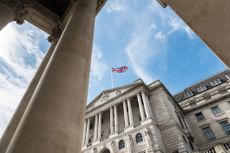
This puts yesterday's update from the Bank of England on the UK's economy into perspective. Governor Mervyn King donned his hob-nailed boots to trample all over any green shoots, talking about a "slow and protracted" recovery with the outlook "unusually uncertain".
The Bank "isn't buying the 'it's all over' mood that seems to be sweeping over investors and market pundits", says Rob Carnell of ING Bank, who reckons that even the Bank's "relatively downbeat" growth projections might be too bullish. "UK growth could linger at sub-trend levels for a lot longer than the Bank is assuming".
That's City-speak for "we're stuck with this mess for ages".
And there's another twist. "The most interesting nugget we gleaned from Mr King", says Edmund Conway in The Telegraph, "is that he seems in favour of a seriously more far-reaching nationalisation of the British banking system than we've seen so far."
Now the Bank Governor's no socialist. So you can be pretty sure that if he's thinking on those lines, it's because more banks will be going bust, and will need extra state bailouts before they can function again. Which would cost yet more public money that the UK just hasn't got.
Land Securities' miserable update
And just to confirm that the bulls have been getting ahead of themselves, Britain's biggest property developer Land Securities produced a miserable update yesterday. Firms like this suffer when their tenants either won't or can't pay the rent. And what did we see? Not only was the loss, caused by the asset value dropping by more than a third, four times that of a year ago, the company also warned that vacancy rates would rise and rental values fall as more tenants go to the wall. It sounds like the real pain is yet to come.
So regardless of when it falls over the next few years, Tax Freedom Day's not going to be a time for celebration. And regardless of stock market rallies, I wouldn't be planning to buy into Britain's consumer-dependent companies for a long time.
Our recommended article for today
While gold continues on its bull rull, platinum and palladium have been underperforming. Martin Spring examines why, where their markets may be going, and how to invest in them.
Published in
Economics
| More
articles
by
David Stevenson
Related articles
-
Mar 19, 2010
-
Mar 19, 2010
-
By John Stepek, Mar 17, 2010
-
By John Stepek, Mar 15, 2010
FREE - MoneyWeek's daily investment email
Our free daily email, Money Morning, is an informative and enjoyable analysis of what's going on in the markets. Written by our Editor, John Stepek, and guest contributors.
Sign up FREE to Money Morning here.